Introduction:
Savannah cats and Bengal cats. What’s the difference? In this article we’ll provide some insight into the differences and similarities between these two hybrid breeds.
History and Origin
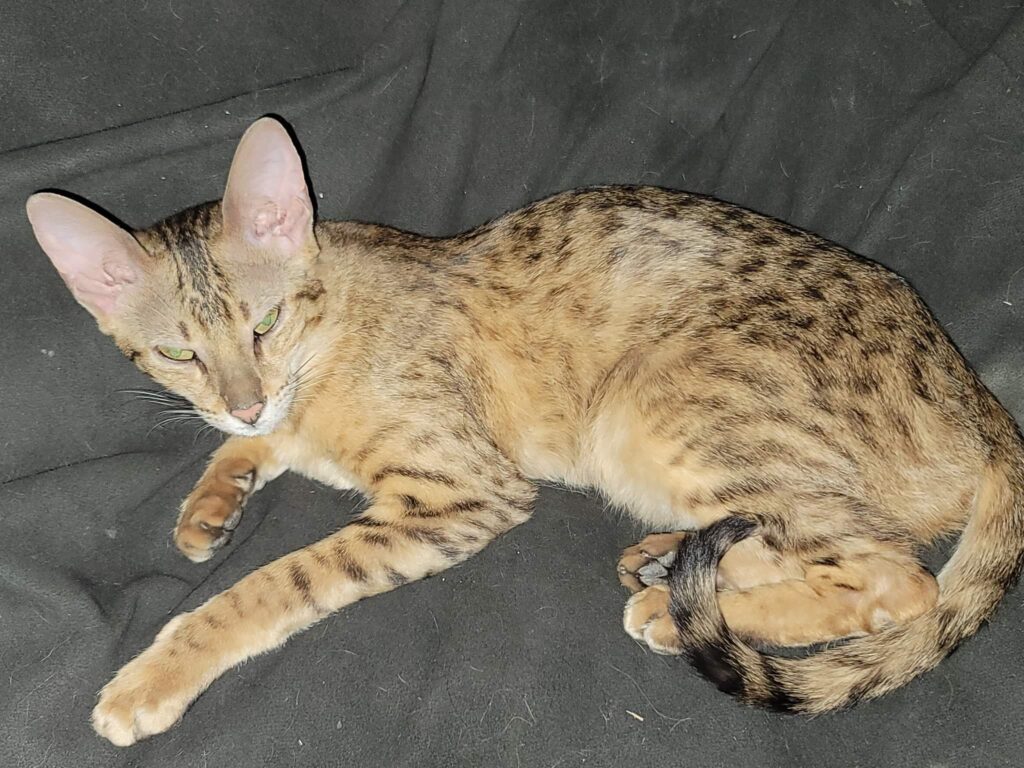
Savannah Cats are a hybrid cat breed created by crossing a domestic cat with the wild African serval. The first Savannah Cat was born in Pennsylvania in 1986 as a result of crossing a male serval and a Siamese cat. The kitten being named “Savannah”, inspired by the kitten’s wild, spotted appearance. As a result, the Savannah cat was created and later accepted as a legitimate breed. They retain the look, physique, and inquisitive nature of a wild Serval while having the tameness of a house cat. Early-generation Savannahs (F1–F3) can exhibit more wild behaviors, such as strong hunting instincts or wariness of strangers, due to their closer serval ancestry. Later generations (F4–F7) are generally more social and adaptable.
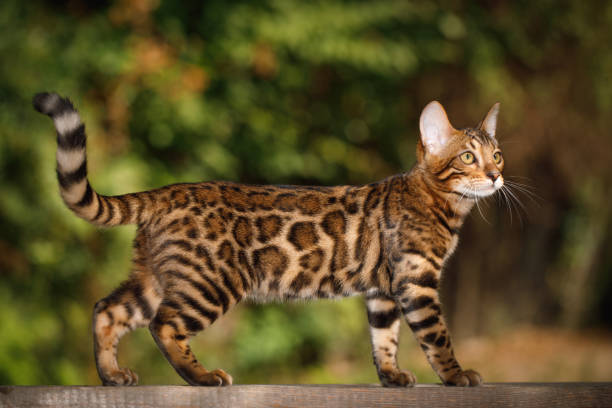
Bengal Cats are a hybrid breed that result from the cross between a domestic cat and the Asian leopard cat. Cross breeding has taken place since the early 1900s, but the breed wasn’t considered established until the 1970s. Bengals were recognized by TICA in 1983 and have since become one of the most popular hybrid breeds. Unlike Savannahs, Bengals are typically further removed from their wild ancestors, with most modern Bengals being at least four generations (F4 or later) from the Asian leopard cat. This distance from their wild roots makes them more consistent in temperament and appearance.
What are African Servals?
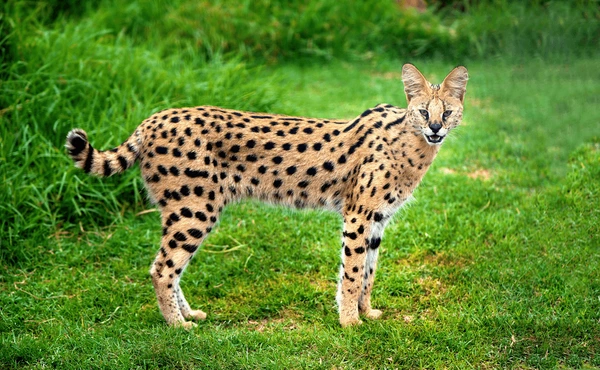
Servals are a wild cat breed native to sub-Saharan Africa. They were known to be revered and even kept as pets by ancient Egyptians. Their size is much larger than a domesticated cat, weighing up to 40 lbs. African servals have large ears, long legs, and an elongated body. Their coat is usually tan with black spots but there are 4 different identified Serval colors total:
- Golden (standard): The most common, with a golden-yellow to tawny base color and black spots/stripes.
- Brown: A darker, brownish variant of the standard coat, often with similar black markings.
- Melanistic (black): All-black coat due to excess melanin; the spots may be faintly visible in certain lighting.
- White (leucistic): Rare all-white or pale cream coat, sometimes with faint markings; this is distinct from albinism. Leucism is a genetic condition reducing pigmentation, results in a partial or complete loss of color but retains normal eye color (unlike albinism). These white servals are extremely rare.
Servals are the second fastest cat after the cheetah and are excellent hunters. In the wild they are solitary carnivores, hunting small prey animals. A Serval’s diet usually consists of rodents, birds, frogs, insects, or reptiles. They typically live 10 to 12 years in the wild and can live up to 20 years or more in captivity. Ownership of Servals is legal in some U.S. states, with some requiring a permit.
What are Asian Leopard Cats?
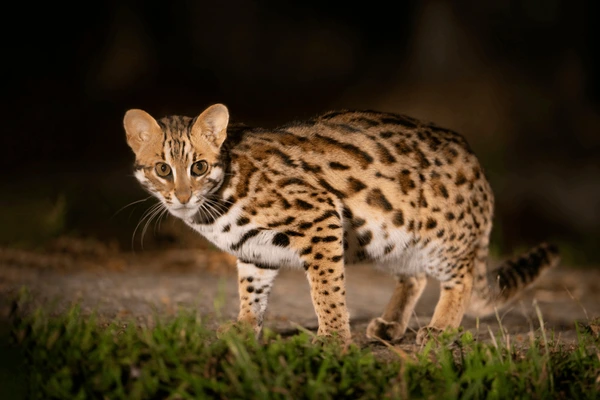
Leopard cats are a small wild cat native to continental Southeast Asia. They have the widest geographic distribution of all felines and their habitat is varied, including tropical forest, scrubland, pine forest, second-growth woodland, semi-desert, and mountainous areas up to 3000 meters. They grow up to 6-15 pounds and are similar in overall size and shape to the domestic cat but have longer legs. Size and appearance vary greatly. Asian leopard cats typically have a distinctive coat with a range of colors and patterns. Their fur is generally short, dense, and soft, with a background color that can vary from:
- Yellowish-tan or golden to grayish or reddish-brown.
- Spotted or marbled patterns: They feature dark spots, rosettes, or marbled markings, often black or dark brown, arranged in rows or scattered across the body.
- Some populations may show darker (e.g., in forested regions) or lighter (e.g., in open habitats) coats, depending on their environment.
- Rare variations include melanistic (black) forms, though these are less common.
The belly is usually lighter, often white or cream, with darker markings. Their coat patterns provide excellent camouflage in their natural habitats, such as forests and grasslands across Asian leopard cats are solitary carnivores in the wild. They are great climbers and spend a lot of time in trees. While they can be great swimmers, they usually do not do so. They hunt for small prey such as rodents, lizards, birds, amphibians, and insects. Ownership of Asian leopard cats is regulated, but allowed in some states,
Bengal & Savannah Similarities:
- Both are hybrid Breeds
- Both are renowned for their beautiful coats and exotic stature
- Both are intelligent and have playful temperaments
- Both are accepted as official breeds by TICA (The international Cat Association)
- Both have similar laws regarding their ownership, usually pertaining to their status as a hybrid breed
- Both have similar diets
- Both require more physical and mental stimulation than a typical domesticated cat
- Both typically have a lot of genetic diversity in their lineage due to being hybrids
Bengal & Savannah Differences:
- Savannah cats are generally larger, longer, and taller than Bengal cats due to their serval ancestry. Bengals are more compact and muscular.
- Savannah cats resemble their wild ancestor more than the Bangle cat resembles the Asian leopard cat
- Bengal cats have more variation between their coat pattern, whilst savannahs are typically a more standard color with black spots across their coat.
- Bengals often have green eyes
- Bengals can be more independent and self-entertaining. The savannah typically likes more human attention as well as companion kitties to play with, although savannahs can be more reserved while Bengals can be more outgoing with strangers.
- Savannah cats have solid black spots across their body, while Bengals can have Even melanistic Savannahs have spots.
- Savannahs are known for their “ocelli,” distinctive white markings on the backs of their ears that resemble eyes, a trait inherited from the serval.
- Bengals are more vocal than Savannahs, often using a range of meows, chirps, and growls to communicate.
- Savannah cats have extra collar bones that are clearly visible that come from their serval lineage.
Which Breed Should I Choose?
Which of these two breeds to choose comes down to preference, appearance being a key difference between the two breeds with slightly nuanced differences in temperaments although every kitty is different and personalities will vary. Both require extra care than a typical domestic breed and share similar diets, requiring more protein than a typical domestic cat breed. When searching for a bengal cat or savannah cat breeder you should make sure socialization is a top priority for the breeder due to the wild nature of the two breeds. This is especially true for lower number Fs where potential owners may not know what they are getting into with poor socialization unfortunately leading to the owners rehoming their hybrid cats. By understanding their origins, physical traits, temperaments, and care needs, you can choose the breed that best aligns with your lifestyle and expectations, You should do as much research as possible and hopefully this article helped in your understanding of these two beautiful hybrid breeds.